
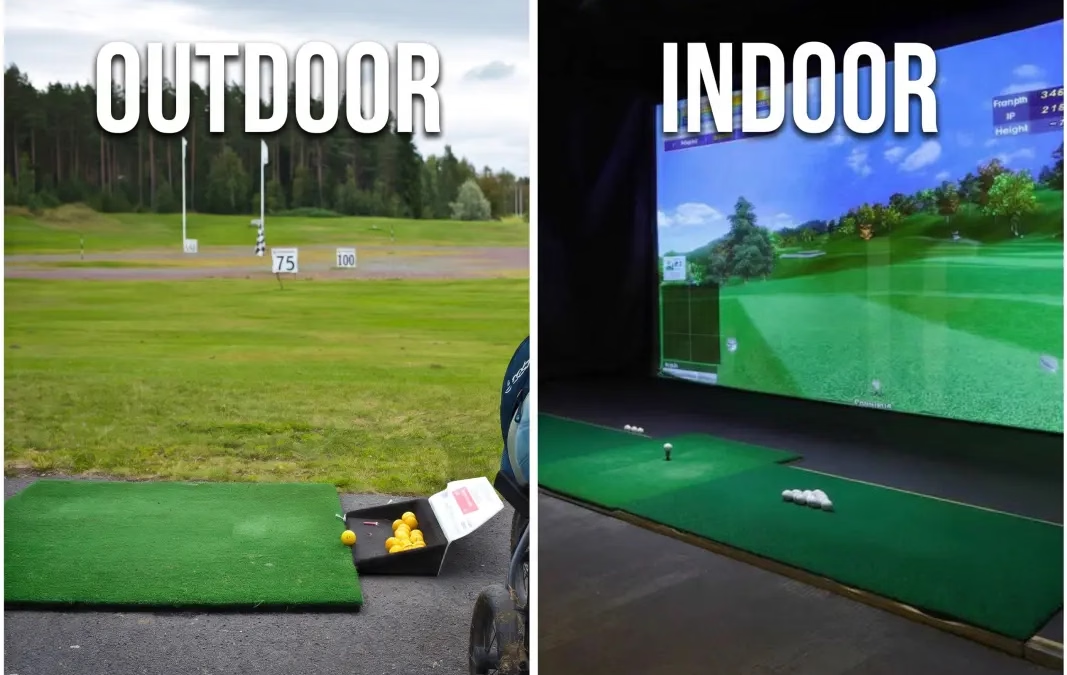
The short answer
An outdoor range shows you real ball flight; an indoor simulator measures the shot at impact and calculates the flight, but gives you numbers on every swing. Indoors you also lose weather, darkness and the season as limits, and you hit off a mat instead of grass.
What actually changes when you move inside:
- Ball flight: you watch a few meters of real flight into a screen, then a simulated flight based on measured speed, launch and spin.
- Feedback: every shot gets carry, ball speed, launch and spin. Most outdoor ranges give you none.
- Surface: mats are more forgiving than grass, so a slightly heavy shot can look fine.
- Conditions: no wind or cold. Cold air alone can cost a few yards of carry outside.
- Access: indoor bays run year-round and, at self-serve sites, 24/7. Toronto outdoor ranges mostly run April to early November.
Side by side
| Indoor simulator bay | Outdoor driving range | |
|---|---|---|
| Ball flight | A few meters into a screen, then simulated from measured launch data | The full real flight |
| Shot data | Every shot: carry, ball speed, launch, spin; club data on some systems | Usually none; some ranges have ball-tracking bays |
| Surface | Hitting mat | Mats, sometimes grass tees |
| Balls | Premium range balls; you can bring your own | Range balls, which fly shorter than premium balls |
| Weather | None; simulated conditions are adjustable | Wind, cold, rain and darkness all matter |
| Season and hours | Year-round; 24/7 at self-serve sites | Mostly April to early November, daylight hours |
| Privacy | Private bay for up to 4 people | Shared hitting line |
| Pricing | Per bay, per hour, balls included (Tracer: $18–$32 in winter; 4 players in a Regular bay is $4.50 each for the hour) | Usually per bucket of balls |
| Short game | Approach and putting modes on a virtual green; less feel than real grass | Some ranges have chipping and putting areas |
Ball flight: watched vs measured
Outside, you see where the ball goes but not why. Indoors, you see why (speed, launch, spin) and the simulator shows where it would have gone.
Outdoor distances are estimates. Range flags give you a rough target, but the real distance depends on which mat you hit from, and on how far the grass tees have been moved forward or back that day. Unless you bring a laser rangefinder, you’re guessing your carry. Indoors, the carry of every shot is measured.
An indoor launch monitor reads the ball in the first few meters, then calculates the rest of the flight from those numbers. In our bays, every shot gives you:
-
- Ball speed
- Launch angle and launch direction
- Spin rate and spin axis
- Carry distance, peak height and curve
- Club data in Pro bays: club speed, club path, face angle and attack angle (TrackMan iO data)
How close is simulated flight to real flight? Good launch monitors land close. In an independent indoor test by MyGolfSpy, several consumer units averaged within about 1.4–2.2% of a high-end reference unit on carry. That works out to 2–4 yards on a 150-yard shot.
The trade-off: indoors you never see the ball’s actual landing, roll or reaction to wind. If your goal is learning how a shot flies in real wind, the outdoor range still teaches something a screen can’t.
We have received feedback from many of our customers regarding the distances on TrackManiO, Impact Vision, Uneekor, Foresight, TM4 and more. The truth is they are all good and provide distance numbers comparable to the real world. Often it just comes down to personal preference. There have certainly been times when the numbers are way off and sometimes it’s just a random occurrence and sometimes the system needs calibrating.
Mats, balls and weather
Three things change your numbers before your swing does: the surface, the ball and the air.
Mats are forgiving. On a mat, the club glides into the ball instead of digging. A top teacher told GOLF.com that mats “mask fat shots.” That’s true at most outdoor ranges too, since many hit off mats. If you want honest contact feedback, check the strike on the club face as well as the result.
Ball quality matters. Range balls fly shorter than premium balls: about 2–3% in a Golf Digest test, and 6% for one driver in a GOLF.com test. Outdoor range balls also get beaten up fast by weather and the landing area, so two balls from the same bucket can fly differently. Indoors, the balls stay dry and wear far less. You can also bring your own ball: the launch monitor measures whatever you hit, so you get numbers for the ball you actually play. Make sure the indoor facility you go to refreshes their balls frequently.
Cold air costs distance. Titleist puts it at about 1.5% of carry for every 11°C drop. A 200-yard shot at 21°C carries about 3 yards less at 10°C. Add wind and the gap grows: in a TrackMan study cited by GOLF.com, a 20 mph headwind cut a 300-yard drive to 259 yards of carry. A simulator plays every shot in calm, set conditions, so your numbers stay comparable from week to week.
Take a listen to this Phil Mickelson interview if you want to know what else can affect the distance.
Practice quality: feedback, privacy and timing
The biggest practical difference is how much you learn per ball when you practice indoors.
- Feedback on every shot. Indoors, each swing comes with numbers you can compare: carry, launch, spin, dispersion. Outdoors, you judge by eye unless the range has camera-based ball tracking in its bays.
- Video replay. Premium bays add the Swing Vision cameras, which replay each swing from face-on and down-the-line, so you can see what changed between a good shot and a bad one.
- No buckets. Balls come with the bay and a ball return feeds them back, so you hit as many as your session allows. No choosing between a medium, large or jumbo bucket, and no walking back to refill.
- Short-game modes. Besides the driving range, the simulator has Approach, Putting and Target Practice modes for wedge distances and green reading on a virtual green.
- Privacy and comfort. A private, climate-controlled bay means no line-up, no one watching, and room for up to 4 friends. Many beginners find that easier than a busy range.
- Timing. You can practice in January, in the rain, or after midnight. About 1 in 20 of our bookings start between 11 p.m. and 5 a.m. (see driving ranges open late near Toronto).
What outdoor ranges still do better: real ball flight in wind, grass tees at some ranges, and a short-game area for chipping and bunker practice.
Which to choose
Most golfers get the most from both. A good order: work on a specific drill or swing change indoors, where weather can’t interfere, then take it outside to learn to adapt to wind, temperature and changing conditions.
| Your goal | Better fit |
|---|---|
| Work on a specific drill or swing change | Indoor (no weather variables) |
| Learn to adapt to wind and changing conditions | Outdoor |
| Know your real carry distances for each club | Indoor (every shot measured; outdoors you’d need a laser rangefinder) |
| See how shots behave in wind | Outdoor |
| Practice in winter, rain or late at night | Indoor |
| Hit off grass | Outdoor, at ranges with grass tees |
| Chipping, bunker and short-game work | Outdoor short-game area, if available |
| A private session with friends | Indoor |
| Lowest cost | Indoor during Summer months |
Looking for somewhere to hit? See our guides to driving ranges across the GTA and indoor golf in Toronto, or find a Tracer Golf location.
FAQ
Is an indoor driving range as good as an outdoor one? For measured practice, often better: every shot comes with carry, speed, launch and spin. For seeing real ball flight in wind, an outdoor range is still better.
Do you hit the ball shorter indoors? No. The simulator calculates distance from how you struck the ball, in calm conditions. Outdoor numbers are often shorter because of range balls, cold air and wind.
How accurate are golf simulators? Good launch monitors measure carry within a few percent of high-end reference units in independent tests. Accuracy depends on the system, the ball and correct setup.
Are hitting mats bad for practice? Mats are more forgiving than grass, so a slightly heavy strike can still look good. Many outdoor ranges have you hit off mats too.
Can I practice chipping and putting indoors? Yes. Our simulators have Approach and Putting modes for wedge distances and reading a virtual green. They’re great for distance control, but they can’t copy the feel of real grass and sand. An outdoor short-game area is better for touch around the green.
Sources
TrackMan iO FAQ · TrackMan iO data parameters · MyGolfSpy indoor launch monitor test · Golf Digest: range balls vs premium balls · GOLF.com: range balls tested · Titleist: temperature and ball performance · GOLF.com: weather and ball flight · GOLF.com: mats vs grass